March in Wisconsin has always held the promise of coming in like a lion and going out like a lamb. At our farm, it may come in like a lion, but it goes out with several lambs—Icelandic ones, that is.
Born in March and April at a friend’s certified organic farm just 20 minutes away, the lambs spend each day at their mothers’ sides, learning about milk and hay and grass—it is their education in how to be a sheep. After a few months, the lambs are ready to be weaned, leaving our friend’s farm for our pastures.
Brought to Iceland by Vikings 1100 years ago, Icelandic sheep have remained pure as a result of their isolation there. It is said that the Icelanders’ survival was dependent upon the Icelandic sheep’s meat, fiber, and milk. As one can imagine, the rugged, cold terrain of the country also encouraged the sheep to become extra hardy themselves.
Because growing grain in Iceland is considered to be a difficult proposition, the Icelandic sheep evolved to grow efficiently on grass—thriving on quality pastures, but also surviving when given poorer grazing land. Our sheep get the best of both worlds—excellent pastures, combined with a small amount of certified organic grain. It is this formula that gives our lamb a taste that simply cannot be compared to store-bought meats.
Raising heritage-breed sheep like the Icelandic has given us the opportunity to participate in maintaining this beautiful breed. Our customers, in turn, get to experience the taste sensation of true organic-fed, pasture-raised, heritage lamb. It is a situation which makes one look forward to the cold, wet days of March, knowing that they signal the coming of another lambing season for Morning Star Family Farm.
Wednesday, March 26, 2014
Friday, December 20, 2013
Philippine Typhoon Relief Fund Progress--Thank you!
With many thanks to all who have sent donations, we have collected $850 to date for the Philippine Typhoon Relief Fund. A wire for the entire amount, less the bank's transfer fee, will be sent to Fr. Bart Pastor this coming week in order to arrive before Christmas. We will send another donation in January to help with their ongoing needs, so don't despair if you haven't gotten a check sent yet. There is still time!
[We have sent the final wire and are no longer accepting donations.]
Thank you again to all who have donated, either to our fund or through other organizations. The need is so great, but even our small efforts are making a difference. We look forward to sharing with you happy news from Fr. Bart after he receives the wire; we will update you all then. Thank you and may God bless you for your generosity.
[We have sent the final wire and are no longer accepting donations.]
Friday, November 29, 2013
Help Us Help Others
200+ mile per hour winds. Seafaring ships picked up and carelessly dropped in residential areas. Roofs and walls of homes and buildings blown out of existence. Over 1800 killed -- that's more than double the body count of Philippines' second most deadly typhoon. These are the results of Typhoon Yolanda/Haiyan which struck central Philippines in early November. According to news sources, over 673,000 are displaced and they still need help...your help.
If you would like us to keep you informed about the progress of the Philippine Typhoon Relief Fund, including the amount of money collected and the dates that the funds are wired to Fr. Bart, please include a note with your check, or send us an email.
Thank you in advance for your generosity. May God bless you and reward you.
As we remember all that we are thankful for on this Thanksgiving weekend, I would like to thank all of you who have expressed concern for my family in the Philippines. Thank God they have been spared as they reside in northern Philippines while the typhoon ravaged the central region of the country. Our family friend, Fr. Bart Pastor, a priest in Tacloban City, was not so fortunate. He and his community were trapped in the middle of this natural disaster. The following bio about him is written by my mother:
Fr. Bart Pastor is close to us, even from our Jakarta days. He is a Thomasian, UST (Univ. of Santo Tomas) Theology grad in 1967. He has written books, workshop materials, organized conventions and conferences, discipleship programs attended by local and foreign participants in their Paraclete Renewal Center in Tacloban. His community has developed and formed self sustaining projects from farming, constructing school projects which their own qualified members implement...all these project assets and property and housing, farms were all damaged or destroyed by [Typhoon] Yolanda. He is a simple, unassuming, gentle, fatherly, resourceful, selfless servant of God...and anyone who meets him for the first time surely gets beholden by this holy priest.
Fr. Bart Pastor has a unique ministry; he runs a retreat center sustained by its own farm which, in turn, provides jobs and opportunities for the locals. My parents lost touch with him after Typhoon Yolanda/Haiyan struck the area on November 8, 2013. About a week later, they finally received a text message from Fr. Bart saying that he was safe but that the typhoon claimed the lives of at least ten people from his community.
Here are some actual excerpts from his text message to my parents:
...no electricity, batt, cellsite, load, radio, tv, food, water. We lost 10 members and counting. Physical damage to Paraclete, agricultural n livestock estimated 12-15 million (Philippine Pesos). D gudnews is we r still alive n surviving, d paraclete students n der families although no roofs n walls over dem. So i invited dem to stay @ paraclete.... We r eating root crops blown coconuts unripe bananas by students who r still in hi spirits n prayin am n pm.
...Yes u deposit to metrobank ac later coz no banks r open yet afteryolanda.... I got out...we had to break d fallen cement posts just enuf height for the survivor to pass.... People der r hungry esp children in fact I invited several to stay at paraclete chapel, dorm....
...Foundational centr not destroyed, infact it was instrumental insaving lives of our immediate neibors who took refuge n 2nd n 3rd flrs. 4 floating bodies r still behind. Our next neiybors homes r totally out. the place where I stay completely gone walls n roofs.
...Stations 10-13 n risen Christ chapel gone. Annies 10 cottages my residence all gone.piggery n poultry n veggies n fruit n foresttrees n coco trees complete gone. Trees n coco r headless.... We shall rise agin by Gods grace n ur help!!!!!
![]() |
| People's faith persists in the wake of the typhoon as they worship in a roofless church. |
Sometimes when we hear about tragedies that occur halfway around the world we can wonder if there is a way we can help, or if they are just too far away for us to be able to make a difference. We would like to give you the opportunity to help someone who is on the front lines of this disaster, and to help his efforts directly.
We are setting up a Philippine Typhoon Relief Fund account at a local bank here in Hartford. Soon you will be able to send checks directly to that account so that we can wire the funds to Fr. Bart in Tacloban City.
This is not a tax-deductible donation, but will go directly to Fr. Bart and his efforts to feed, clothe, and house those in his area who were struck by the typhoon.
We are setting up a Philippine Typhoon Relief Fund account at a local bank here in Hartford. Soon you will be able to send checks directly to that account so that we can wire the funds to Fr. Bart in Tacloban City.
[We have sent the final wire and are no longer accepting donations.]
This is not a tax-deductible donation, but will go directly to Fr. Bart and his efforts to feed, clothe, and house those in his area who were struck by the typhoon.
If you would like us to keep you informed about the progress of the Philippine Typhoon Relief Fund, including the amount of money collected and the dates that the funds are wired to Fr. Bart, please include a note with your check, or send us an email.
Thank you in advance for your generosity. May God bless you and reward you.
Wednesday, July 31, 2013
More Fun than Expected
The children came here because their parents had signed them up for Farm Explorers' One-Day Camp, a camp designed to allow children to get a glimpse of farm life, plus learn why animals are happier and healthier when they live outside in the fresh air and sunshine.
10:00 -- Orientation
After checking in, the group gathered under the canopy and began working on an activity packet that included coloring pages of the animals they would see later in the day. At the sound of the cow bell (what else?) we started with a prayer, an explanation of the day's plan, and, most importantly, a discussion about how to stay safe around the farm.
10:15 -- Morning Activities
The children were divided into two groups and rotated through two learning stations. At the Chick Station, Group 1 learned all about the one week old chicks growing in the granary of the big barn.
| The Chick Station (It was 90 degrees in there! But that's how the chicks like it.) |
| Gently playing with baby chicks |
At the Pasture Station, Group 2 learned about the animals we raise on the pasture: broiler chickens, cattle, and sheep.
| The Pasture Station |
| Learning about the origins of grass-fed beef |
| Meeting our pasture-raised chickens |
| Feeding the hogs broccoli from our garden while waiting for the lunch bell |
12:00 -- Lunchtime!
The sound of the cow bell called everyone to the canopy for lunch. Plenty of shade and ice water made a wonderful combination! A little free time after lunch gave the kids time to pet the farm dog, cats, and rabbit. The more "mechanically-inclined" enjoyed riding on the parked tractor, skid steer, and riding lawn mower.
12:30 -- Afternoon Activities
In the second half of the day, we offered two more learning stations for the children. The Egg Station involved collecting eggs from the chickens' nest boxes, washing and drying them, and then packing the eggs into a mini-carton to take home.
The Garden Station gave the kids a tour of the 1.2-acre fruit orchard and vegetable garden. The children were happy to identify plants like corn and pumpkin, and learn about others like grape vines and potato plants. Then the kids got to harvest a basket-full of sugar snap peas to take home with them.
2:00 -- Dismissal
While our main goal in hosting this camp was to educate the kids about why we do the things we do, we also had, at the forefront, a desire for the kids to have a lot of fun. While it was obvious that the children had a good time (one little boy even said, "That was more fun than I expected!"), I think the adults may have enjoyed the camp even more than the campers.
We have to make many decisions on our farm; we always make those decisions with an eye towards those who will be eating the foods that we produce. There is something special about seeing firsthand the children who are benefiting from those decisions that we are making. Fifteen happy, healthy children enjoying the safe, chemical-free farm we have worked hard to create--it was a beautiful sight to see.
| The tractor, Old Red, carries the happy campers during the group photo. |
Thanks for a great Farm Camp, everyone!
We hope to see you again next year.
Monday, April 15, 2013
A Winter Recap
This winter has been a productive one for completing projects. First on the list was finishing up the barn pens. The boys built a total of thirteen pens in our 100+ year-old bank barn.
| First, the boys frame out combination stock panels with 2 x 4s. |
| Then they attach the framed panels to 2 x 4 uprights. |
| The final result: modular pens that can be altered as needed for different uses. This one is sized for a newborn calf or young pig. |
| The steers make a great thermometer. If it is over 25 degrees, you will find them outside. |
| Stella goes outside for some sunshine. |
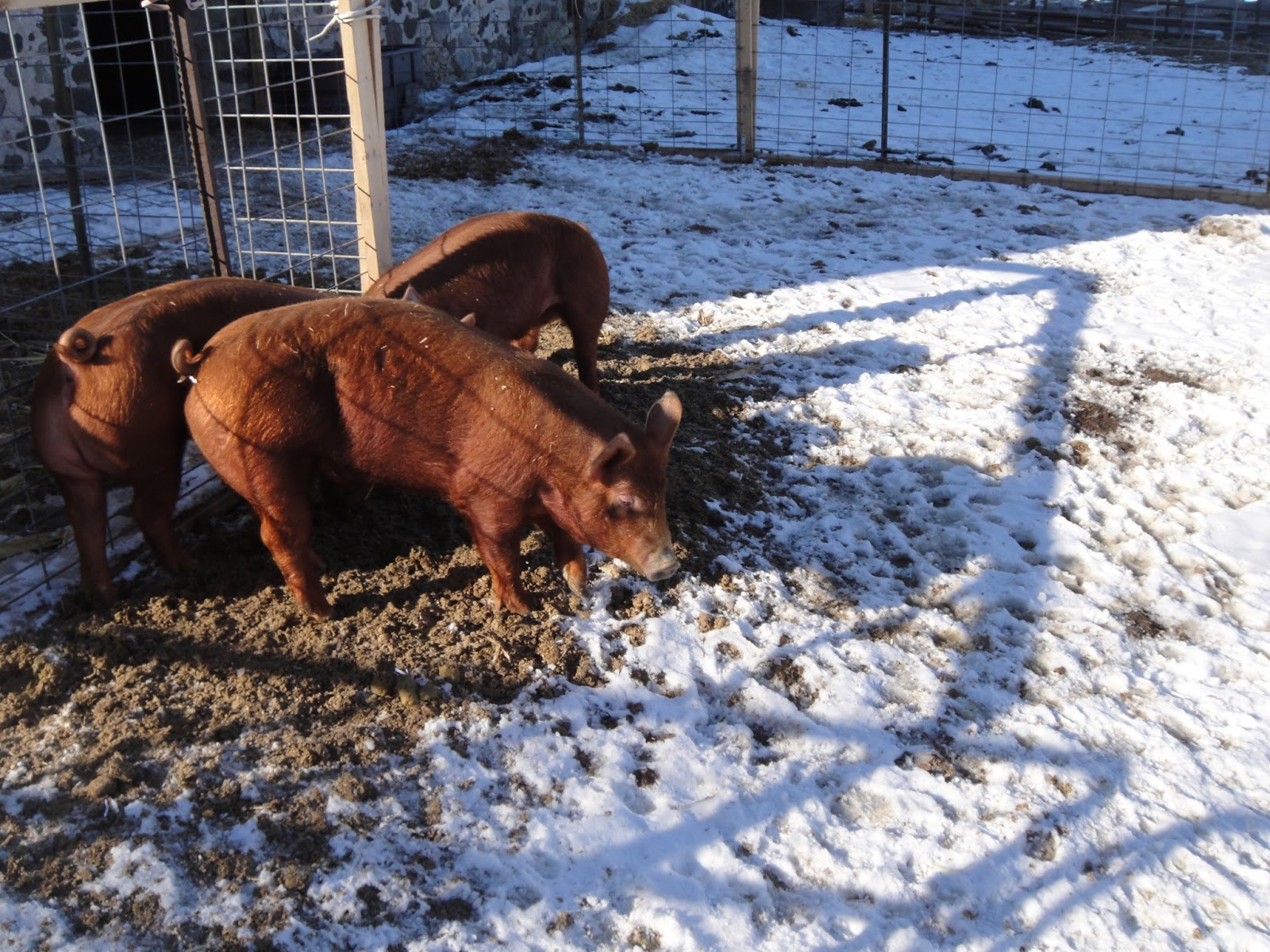
| The growing hogs enjoy the fresh air, too. |
| The chickens, on the other hand, are not thrilled to be out in the snow. They hang out near the coop door until one of the boys shovels a path for them. |
| The inside of the pasture layer house, with roosts on the left and nest boxes on the right. |
| Built on skids, the house can be pulled with our tractor to a different area of the pasture. |
| A view of the back of the layer house, showing the access door to the nest boxes. |
| The completed layer house, ready for a coat of paint. |
Doubled 2 x 6s provide strong skids for the new hog shelter. Dad built the house to be held together with strong bolts as well. As a result, he can build the shelter in our upper barn, then disassemble it for transport to the field. We will use the skids for transport within the pasture as needed.
| Skids on, side walls up, and the beginnings of overhead supports for the hog shelter roof. |
| The heavy steel roof must go up in two sections to be practical. Here is the framing for the first section. |
| The first roof support section, in place on the hog shelter. |
In the meantime, check out our website for our current offerings: cuts of Grass-Fed Beef, Organic-Fed Stewing Hens, and Organic-Fed Eggs. We are also taking orders for upcoming organic-fed, pasture-raised products: Broiler Chickens in summer 2013 and Pork, Lamb, and Turkey in fall 2013. Send us an email or give us a call to reserve yours today.
Wednesday, October 24, 2012
This Little Piggy Had Ten
When we last posted a blog, our Tamworth sow, Stella, had just arrived at our farm and was adjusting to her new life in our fields. She had a wonderful time of it--eating and digging in the cover crop first, then, later, munching on organic, heirloom corn stalks and cobs as they stood in our garden.
| Stella, mowing down a cover crop, Summer 2012 |
We visited her at least once a day, usually bringing her a treat or two from the garden (tomatoes and cauliflower top her list of favorites), but she always seemed sad to see us leave. Pigs don't like to be alone. They are very social creatures, living in groups even in the wild. We knew that Stella wouldn't be alone for long, what with her piglets coming soon and our plan to save one of her girls to live with her from now on, but we just couldn't convince Stella of that.
| Co-engineer, Raphael, in the creep area of Stella's farrowing pen |
As summer waned, and the leaves began to turn color, we knew it was time to get serious about building a farrowing pen for Stella in the big, old barn. Kathy came up with a skeleton-like plan which showed how large each stall should be, but the real engineering took place late in the evening each night as Robin and Raphael took that plan and turned it into real, tangible walls and gates.
| Stella investigates her new home |
On conventional pig farms, sows give birth in farrowing crates, narrow areas which confine the sow, not even allowing her to turn around. The reason given is that this helps to prevent the sow from lying on her piglets. The reality is that it restricts the sow's movement, even to the point of causing bed sores, and can wreak havoc with nursing, as some of the sow's teats may be blocked by the bars which hold the sow. So what about the danger of sows crushing their piglets? On commercial farms, sows are selected based on number of pigs in a litter, leanness of meat, and body conformation. On small, private farms, and in heritage breed pigs in general, sow selection is based, among other things, on good mothering skills. This gives us sows that know how to care for their pigs--including how to avoid lying on them--even when not confined in farrowing crates.
| Marcelino and Stella at the farrowing pen |
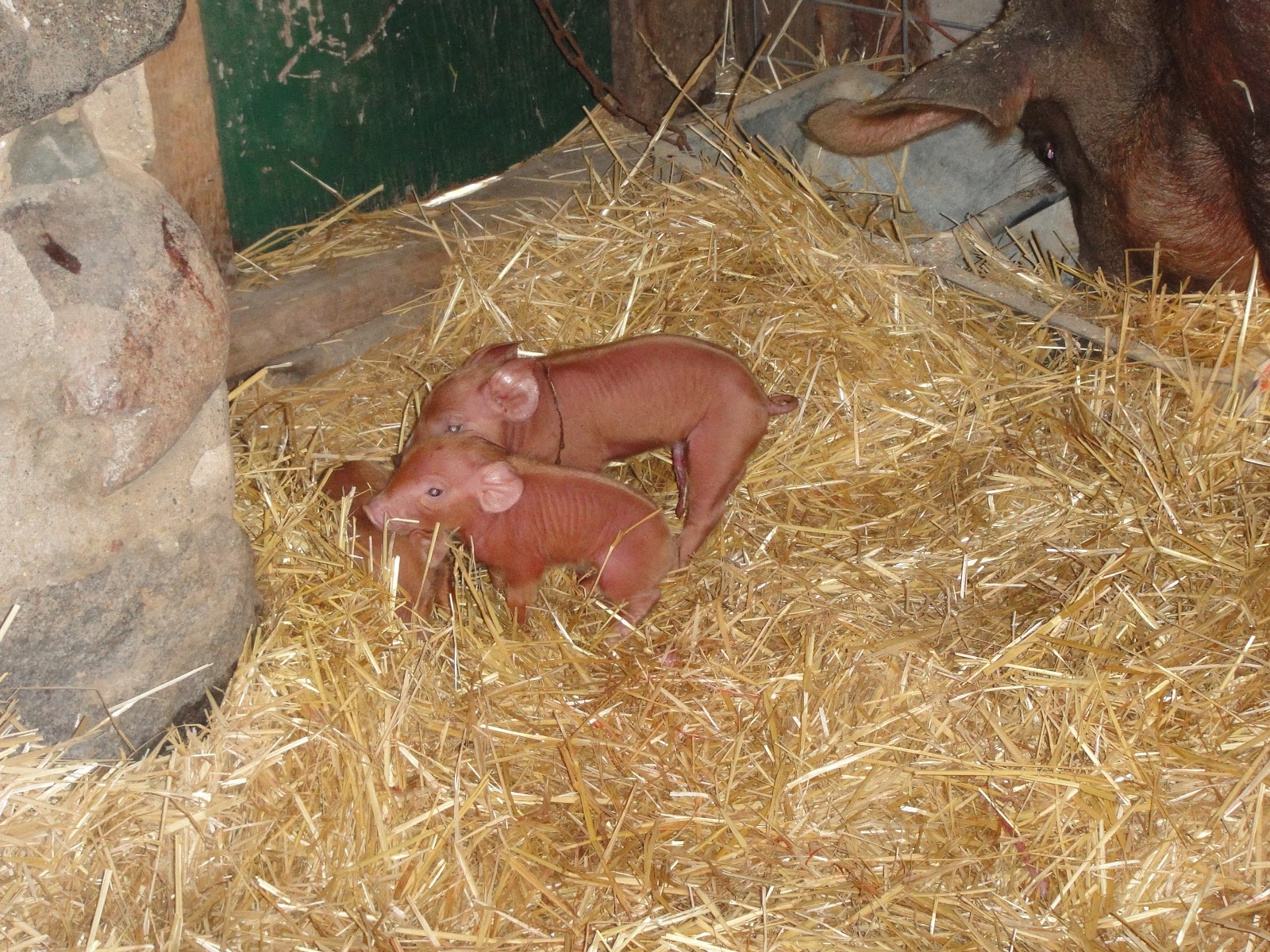
| Surprise! The piglets are here! |
Upon returning home from church last Sunday, we found Stella accompanied by seven piglets! She probably had begun farrowing (giving birth) more than an hour before, as the piglets continued to come about every 15 minutes thereafter. She farrowed 14 piglets, with 10 surviving. Way to go, Stella!
| Mama Stella nursing her piglets |
| Proud Swine Manager, sketching the new family |
| Piglets napping in the creep, with Stella looking on |
| Ten Little Sausages |
| Life is Good |
Wednesday, August 8, 2012
A Star Comes to Our Farm
We never would have met Stella unless we met Harvey Work. Harvey was giving a two-day Natural Pig Workshop at Moraine Park Technical College in Fond du Lac, Wisconsin. As a leading authority on pastured pigs in the area, Harvey was bringing in a team of professionals, including other natural pig farmers and a pasture management expert, to teach us about the new farming renaissance in raising animals on pasture.
My wife and I brought our eleven year old son, Marcelino, along to this presentation since we have been grooming him to be our farm's Swine Manager. Marcelino first became interested in pigs through his friend down the road who has been growing out pigs for the Washington County Fair for two years already. Because of his friend's influence, Marcelino had acquired two pigs, Ham and Bacon, one of which was to be shown at the Washington County Fair a few weeks after the Natural Pig Workshop. While he was enjoying raising the two pigs, Marcelino had a special wish--to have a sow and to watch her farrow and mother a litter of piglets.
When they first met, Harvey was impressed with Marcelino's motivation in our farm's pig enterprise and by the end of the lecture series, Harvey proposed an offer to us that we couldn't refuse: to adopt one of his already-bred Tamworth sows. It was a match surely made in heaven, right down to the details: the sow's name, Stella, means "star" in Latin, making it so fitting that her home will be at Morning Star Family Farm.
Our first line of business was to prepare a home for our new "guest" that would give her the best possible pasture, considering the drought we are experiencing. We had put in a cover crop of heirloom soybean plants, oats, and white clover that was about ready to be turned under. Between their hooves and their snouts, pigs make great rototillers, so we decided to give Stella small sections of the cover cropped area, allowing her to turn the plants under for us. That would nourish the soil, while nourishing Stella at the same time.
Finally the grand day arrived and Stella moved into her new home. After a bit of sniffing around, she dug right into her certified organic feed and has been a contented sow ever since.
Stella was born and raised at Harvey Work's farm in Eden, Wisconsin, just 30 minutes north of our farm. She is a two year old purebred Tamworth sow that has already had three litters with no fewer than eight piglets each. She has a special place in Harvey's heart, but the other sows at his farm were ostracizing her and not allowing Stella to have a fair share of feed. As Stella started losing weight, Harvey realized it was time to explore other options for her. When he met us at the workshop in Fond du Lac, Harvey thought that Stella might find a good home at Morning Star Family Farm, and I think we've found a match.
Stay tuned--little piglets are due to arrive in October 2012.
My wife and I brought our eleven year old son, Marcelino, along to this presentation since we have been grooming him to be our farm's Swine Manager. Marcelino first became interested in pigs through his friend down the road who has been growing out pigs for the Washington County Fair for two years already. Because of his friend's influence, Marcelino had acquired two pigs, Ham and Bacon, one of which was to be shown at the Washington County Fair a few weeks after the Natural Pig Workshop. While he was enjoying raising the two pigs, Marcelino had a special wish--to have a sow and to watch her farrow and mother a litter of piglets.
| Marcelino showing "Bacon" at the Washington County Fair, 2012 |
When they first met, Harvey was impressed with Marcelino's motivation in our farm's pig enterprise and by the end of the lecture series, Harvey proposed an offer to us that we couldn't refuse: to adopt one of his already-bred Tamworth sows. It was a match surely made in heaven, right down to the details: the sow's name, Stella, means "star" in Latin, making it so fitting that her home will be at Morning Star Family Farm.
Our first line of business was to prepare a home for our new "guest" that would give her the best possible pasture, considering the drought we are experiencing. We had put in a cover crop of heirloom soybean plants, oats, and white clover that was about ready to be turned under. Between their hooves and their snouts, pigs make great rototillers, so we decided to give Stella small sections of the cover cropped area, allowing her to turn the plants under for us. That would nourish the soil, while nourishing Stella at the same time.
| The Quonset hut for Stella amid rows of soybeans, oats, and clover |
Finally the grand day arrived and Stella moved into her new home. After a bit of sniffing around, she dug right into her certified organic feed and has been a contented sow ever since.
| Harvey Work, Marcelino, & Stella |
Stella's Story:
| Welcome home, Stella! |
Stay tuned--little piglets are due to arrive in October 2012.
Subscribe to:
Posts (Atom)