Wednesday, July 31, 2013

More Fun than Expected

Our education about healthy living should not begin as an adult, but rather, as a child.  In order to bridge the gap between the farm and one's dinner plate, on Monday, July 15, 2013, a group of young children descended upon our farm. 

The children came here because their parents had signed them up for Farm Explorers' One-Day Camp, a camp designed to allow children to get a glimpse of farm life, plus learn why animals are happier and healthier when they live outside in the fresh air and sunshine.  


10:00 -- Orientation
After checking in, the group gathered under the canopy and began working on an activity packet that included coloring pages of the animals they would see later in the day.  At the sound of the cow bell (what else?) we started with a prayer, an explanation of the day's plan, and, most importantly, a discussion about how to stay safe around the farm.

10:15 -- Morning Activities
The children were divided into two groups and rotated through two learning stations.  At the Chick Station, Group 1 learned all about the one week old chicks growing in the granary of the big barn.  

The Chick Station
(It was 90 degrees in there!
But that's how the chicks like it.)

Gently playing with baby chicks

At the Pasture Station, Group 2 learned about the animals we raise on the pasture: broiler chickens, cattle, and sheep. 

The Pasture Station
Learning about the origins
of grass-fed beef
Meeting our pasture-raised chickens
Feeding the hogs broccoli from
 our garden while waiting
for the lunch bell

12:00 -- Lunchtime!
The sound of the cow bell called everyone to the canopy for lunch.  Plenty of shade and ice water made a wonderful combination!  A little free time after lunch gave the kids time to pet the farm dog, cats, and rabbit.  The more "mechanically-inclined" enjoyed riding on the parked tractor, skid steer, and riding lawn mower.


12:30 -- Afternoon Activities
In the second half of the day, we offered two more learning stations for the children.  The Egg Station involved collecting eggs from the chickens' nest boxes, washing and drying them, and then packing the eggs into a mini-carton to take home.  

The Garden Station gave the kids a tour of the 1.2-acre fruit orchard and vegetable garden.  The children were happy to identify plants like corn and pumpkin, and learn about others like grape vines and potato plants.  Then the kids got to harvest a basket-full of sugar snap peas to take home with them.


2:00 -- Dismissal
While our main goal in hosting this camp was to educate the kids about why we do the things we do, we also had, at the forefront, a desire for the kids to have a lot of fun.  While it was obvious that the children had a good time (one little boy even said, "That was more fun than I expected!"), I think the adults may have enjoyed the camp even more than the campers.  

We have to make many decisions on our farm; we always make those decisions with an eye towards those who will be eating the foods that we produce.  There is something special about seeing firsthand the children who are benefiting from those decisions that we are making.  Fifteen happy, healthy children enjoying the safe, chemical-free farm we have worked hard to create--it was a beautiful sight to see.


The tractor, Old Red, carries the happy campers during the group photo.
     
Thanks for a great Farm Camp, everyone!
We hope to see you again next year.


Monday, April 15, 2013

A Winter Recap

It has been a long winter, and it seems that spring is taking its sweet time in arriving this year.  That makes it a great time to share with you what we've been up to this winter at Morning Star Family Farm.

This winter has been a productive one for completing projects.  First on the list was finishing up the barn pens.  The boys built a total of thirteen pens in our 100+ year-old bank barn.  
First, the boys frame out
combination stock panels with 2 x 4s.
Then they attach the framed panels
to 2 x 4 uprights.
The final result: modular pens that can be
altered as needed for different uses.  This one
is sized for a newborn calf or young pig.
While we'd much prefer our animals living outdoors year round, our Wisconsin climate just doesn't work well with that plan.  Instead, we try to bring our animals the best of both worlds during the winter months--24 hour access to the barnyard for fresh air and sunshine, and a cozy, bedded retreat inside the barn for a place to get out of more severe weather.
The steers make a great thermometer.  If it
is over 25 degrees, you will find them outside.
Stella goes outside for some sunshine.

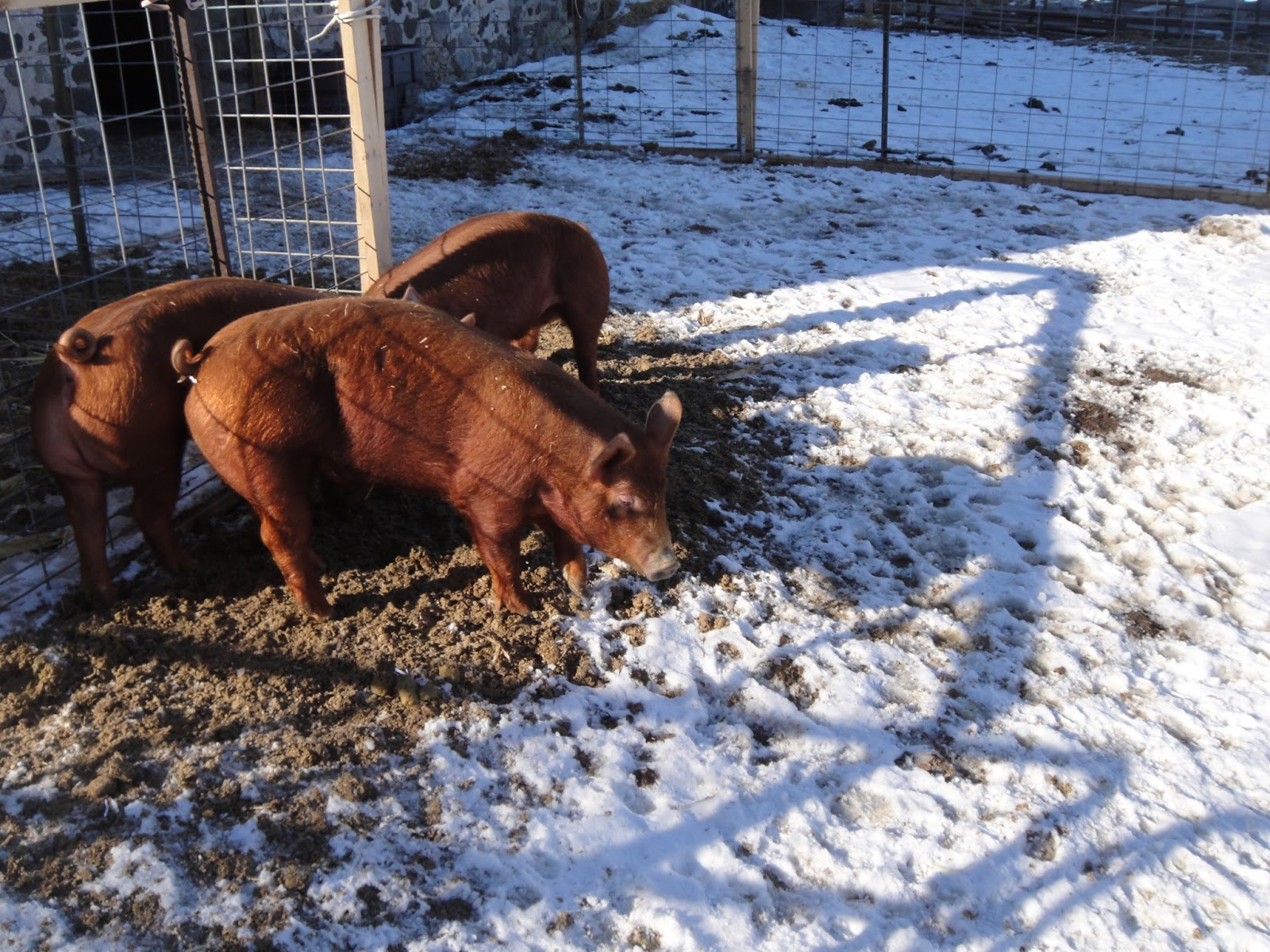
The growing hogs enjoy the fresh air, too.
The chickens, on the other hand, are not
thrilled to be out in the snow.  They hang out
near the coop door until one of the boys
shovels a path for them.
Now that we have survived the 2012 drought, and have seen a lot of precipitation throughout the winter, we are thinking that our pasture will be ready for animal traffic this year.  As a result, we will need pasture housing for both laying hens and hogs.  The pasture layer house was Raphael's project.
The inside of the pasture layer house, with
roosts on the left and nest boxes on the right.

Built on skids, the house can be pulled with
our tractor to a different area of the pasture.

A view of the back of the layer house,
showing the access door to the nest boxes.

The completed layer house,
ready for a coat of paint.
Meanwhile, Dad offered to build the hog pasture housing.  We knew the house needed to be large enough for a litter or two of growing-out hogs, and it needed to be easily divided so we could separate a farrowing sow from the rest of the herd.  The resulting 8 x 16 foot structure meets these criteria and then some.

Doubled 2 x 6s provide strong skids for the new hog shelter.  Dad built the house to be held together with strong bolts as well.  As a result, he can build the shelter in our upper barn, then disassemble it for transport to the field.  We will use the skids for transport within the pasture as needed.
Skids on, side walls up, and the beginnings of
overhead supports for the hog shelter roof.

The heavy steel roof must go up in two 
sections to be practical.  Here is the framing 
for the first section.

The first roof support section, in place
on the hog shelter.
So, despite the snow and cold, it has been a productive winter for us here at Morning Star Family Farm.  Stay tuned as we complete these projects and, once the grass gets growing, move the animals out onto pasture where they can benefit from not only the fresh air and sunshine, but green grass as well.

In the meantime, check out our website for our current offerings: cuts of Grass-Fed Beef, Organic-Fed Stewing Hens, and Organic-Fed Eggs.  We are also taking orders for upcoming organic-fed, pasture-raised products: Broiler Chickens in summer 2013 and Pork, Lamb, and Turkey in fall 2013.  Send us an email or give us a call to reserve yours today.


Wednesday, October 24, 2012

This Little Piggy Had Ten

When we last posted a blog, our Tamworth sow, Stella, had just arrived at our farm and was adjusting to her new life in our fields.  She had a wonderful time of it--eating and digging in the cover crop first, then, later, munching on organic, heirloom corn stalks and cobs as they stood in our garden.  
Stella, mowing down a cover crop,
Summer 2012
We visited her at least once a day, usually bringing her a treat or two from the garden (tomatoes and cauliflower top her list of favorites), but she always seemed sad to see us leave.  Pigs don't like to be alone.  They are very social creatures, living in groups even in the wild.  We knew that Stella wouldn't be alone for long, what with her piglets coming soon and our plan to save one of her girls to live with her from now on, but we just couldn't convince Stella of that.

Co-engineer, Raphael,
in the creep area of Stella's farrowing pen
As summer waned, and the leaves began to turn color, we knew it was time to get serious about building a farrowing pen for Stella in the big, old barn.  Kathy came up with a skeleton-like plan which showed how large each stall should be, but the real engineering took place late in the evening each night as Robin and Raphael took that plan and turned it into real, tangible walls and gates. 
Stella investigates her new home
On conventional pig farms, sows give birth in farrowing crates, narrow areas which confine the sow, not even allowing her to turn around.  The reason given is that this helps to prevent the sow from lying on her piglets.  The reality is that it restricts the sow's movement, even to the point of causing bed sores, and can wreak havoc with nursing, as some of the sow's teats may be blocked by the bars which hold the sow.  So what about the danger of sows crushing their piglets?  On commercial farms, sows are selected based on number of pigs in a litter, leanness of meat, and body conformation.  On small, private farms, and in heritage breed pigs in general, sow selection is based, among other things, on good mothering skills.  This gives us sows that know how to care for their pigs--including how to avoid lying on them--even when not confined in farrowing crates.    
Marcelino and Stella at the farrowing pen
When planning Stella's pen, we knew we wanted to create a farrowing pen which gives the sow a larger area to live in, plus an area for the piglets to retreat to when they are ready for a nap.  This area, called the creep, includes a heat lamp to keep the piglets toasty warm.  Eventually, the creep will also have a piglet feeder with freshly-ground, high-protein, organic feed for the little ones.  A partition which begins eight inches above the floor separates Stella's area from the creep.  This keeps Stella out of the piglets' area, but allows the piglets free access to their mom anytime they'd like.  

Surprise!  The piglets are here!
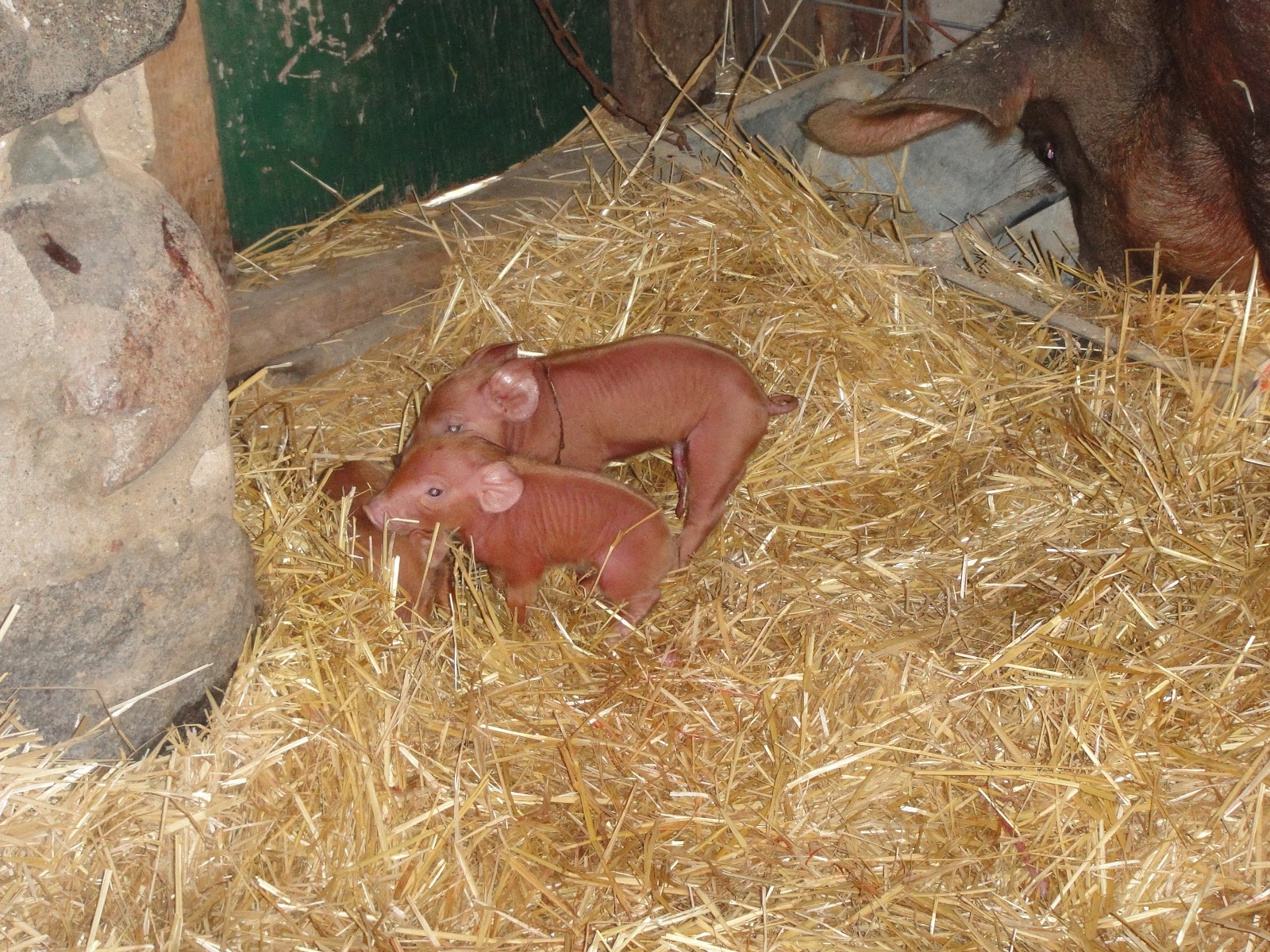
Upon returning home from church last Sunday, we found Stella accompanied by seven piglets!  She probably had begun farrowing (giving birth) more than an hour before, as the piglets continued to come about every 15 minutes thereafter.  She farrowed 14 piglets, with 10 surviving.  Way to go, Stella!
Mama Stella nursing her piglets
Proud Swine Manager,
sketching the new family
Piglets napping in the creep,
with Stella looking on
Ten Little Sausages
Life is Good


Wednesday, August 8, 2012

A Star Comes to Our Farm

We never would have met Stella unless we met Harvey Work.  Harvey was giving a two-day Natural Pig Workshop at Moraine Park Technical College in Fond du Lac, Wisconsin.  As a leading authority on pastured pigs in the area, Harvey was bringing in a team of professionals, including other natural pig farmers and a pasture management expert, to teach us about the new farming renaissance in raising animals on pasture.

My wife and I brought our eleven year old son, Marcelino, along to this presentation since we have been grooming him to be our farm's Swine Manager.  Marcelino first became interested in pigs through his friend down the road who has been growing out pigs for the Washington County Fair for two years already.  Because of his friend's influence, Marcelino had acquired two pigs, Ham and Bacon, one of which was to be shown at the Washington County Fair a few weeks after the Natural Pig Workshop.  While he was enjoying raising the two pigs, Marcelino had a special wish--to have a sow and to watch her farrow and mother a litter of piglets.

Marcelino showing "Bacon"
at the Washington County Fair, 2012

When they first met, Harvey was impressed with Marcelino's motivation in our farm's pig enterprise and by the end of the lecture series, Harvey proposed an offer to us that we couldn't refuse: to adopt one of his already-bred Tamworth sows.  It was a match surely made in heaven, right down to the details: the sow's name, Stella, means "star" in Latin, making it so fitting that her home will be at Morning Star Family Farm.

Our first line of business was to prepare a home for our new "guest" that would give her the best possible pasture, considering the drought we are experiencing.  We had put in a cover crop of heirloom soybean plants, oats, and white clover that was about ready to be turned under. Between their hooves and their snouts, pigs make great rototillers, so we decided to give Stella small sections of the cover cropped area, allowing her to turn the plants under for us.  That would nourish the soil, while nourishing Stella at the same time.

The Quonset hut for Stella amid 
rows of soybeans, oats, and clover

Finally the grand day arrived and Stella moved into her new home.  After a bit of sniffing around, she dug right into her certified organic feed and has been a contented sow ever since.

Harvey Work, Marcelino, & Stella

 Stella's Story:  

Stella was born and raised at Harvey Work's farm in Eden, Wisconsin, just 30 minutes north of our farm.  She is a two year old purebred Tamworth sow that has already had three litters with no fewer than eight piglets each.  She has a special place in Harvey's heart, but the other sows at his farm were ostracizing her and not allowing Stella to have a fair share of feed.  As Stella started losing weight, Harvey realized it was time to explore other options for her.  When he met us at the workshop in Fond du Lac, Harvey thought that Stella might find a good home at Morning Star Family Farm, and I think we've found a match.

Welcome home, Stella!

 Stay tuned--little piglets are due to arrive in October 2012.  


Monday, July 2, 2012

Coming Soon to Your Table: Pastured Broiler Chickens

To show you how we create that flavorful bird sitting on the platter on your dining room table, we would like to take you on a journey that starts on the day the chicks arrive at Morning Star Family Farm.  At the same time we will share with you our top reasons for raising chickens the way we do.


Reason #1...We know what the chickens eat.
You are what you eat.  Do you know what happens to the health of an animal when it consumes genetically-modified foods?  The 2008 Emmy-award winning documentary Food, Inc. attempts to answer this question and the conclusions are unsettling.  One conclusion is that the large-scale production farms are managing to make a profit at the sacrifice of the health and living conditions of the animals and, ultimately, by sacrificing the flavor and nutritional quality of your food.  Our solution to this problem is to raise our chickens on pasture.
Before the chickens get to the pasture, we need to ensure, from the day we get them, that they have a great, healthy start to their life.  We pick up our chicks the day they are hatched at Abendroth's Hatchery in Waterloo, Wisconsin.  The hatchery could send them through the mail, getting them to our farm the day after they hatch.  But sitting in a box on a hot USPS truck would stress the little chickies, and stressed chicks often get sick.
Cornish Cross broiler chicks start in our brooder
When we receive them, the chicks are still living off the rich proteins and fats of the egg's yolk sac.  When they arrive at our farm, we stick their beaks in fresh, warmed water to teach them where to find a drink.  This helps to prevent dehydration and encourages them to drink on their own.  Their natural instinct to peck will lead them to the free-access, certified organic, GMO-free feed we provide--rich in nutrients from cracked corn, whole roasted soybeans and other wholesome ingredients--all custom-ground and mixed for us at a local, certified organic grain mill.


Reason #2...The birds are healthier on the pasture.
According to Jeff Mattocks, a leading authority on poultry nutrition, the #1 cause for disease among poultry is poor air quality.  Tens of thousands of dollars are spent by the mega-industry farms in their livestock and poultry barns to import the air quality of the outdoors to the indoors.  By raising our birds on pasture, their air-quality is as natural as can be.
Moving Day!
Three week-old chicks move to the pasture pen.
Reason #3...The birds are under less stress and more content when on pasture, making them more delicious!
This may sound like some sort of psychobabble, but it has been proven that chickens raised in low-stress environments grow better.  This translates into a more delicious and flavorful bird.  We provide that low-stress environment through the sturdy structure of the movable pasture pen.
Our 10x15 foot pasture pen,
welded by our 13 year-old son, Raphael
Our version of the pasture pen is a 10 foot by 15 foot structure made of welded conduit.  This provides the skeletal framework on which we wrap chicken wire fencing.  A tarpaulin roof over half the pen provides necessary protection from both sun and rain.  The other half of the pen in open to sunlight for the chickens' daily dose of Vitamin D.
Rex, poultry guardian extraordinaire
Our chickens enjoy having plenty of room to move around in the spacious pen.  Between the sturdy structure and our roaming guard dog, the chickens are safe from both aerial and terrestrial predators.  With constant access to pasture as well as certified organic, GMO-free feed, the chickens' ability to forage for bugs and eat chemical-free grasses and legumes allows them to grow in a natural way.  The pen is moved daily to give the birds a new area to roam in and to maintain variety in their diet.  If you look closely, you might catch a smile on one of those chickens!

Content, curious chickens
When we first began our life in farming, our goal was to become self-sustaining.  Since then, more and more of our friends, family members, and now customers have become interested in our venture of pastured poultry and have been positive and encouraging in our method of raising animals.  Much of the interest seems to come from the growing desire to find good, healthy, and delicious food.  We hope you will find all of that here at Morning Star Family Farm.  Our first batch of meat chickens will be ready for purchase in August 2012.  Feel free to email us or call to place your order!


Saturday, May 12, 2012

Seeds of Life

Every day we make choices.  When we get out of bed in the morning we choose how we will spend our day.  When we pick what we will eat for lunch we make a decision that can bring us closer to or further from health.  And when we order seeds for our gardens we choose what industry we wish to support.
One pound of Reid's Yellow Dent Corn, an heirloom feed corn
In planning our garden for this year, we decided to plant only heirloom seeds.  Another word for heirloom seeds is "Open Pollinated" or "O.P.".  Until the 1930s, all commonly available seeds were O.P.--that is, they bred true.  If you save seeds from an O.P. tomato plant this year and plant them next year, barring cross-pollination by other tomato plants, you will grow tomatoes that look and taste like the tomatoes from the original plant.  So, when we made the choice to grow O.P. varieties, we were also making it possible for us to save our own seeds for next year, if we want to take that step.  
Lancaster Sure Crop Dent Corn--look closely; it looks like
candy corn--turns out that's what corn used to look like!
Our primary reason for choosing heirloom seeds, however, is nutritional.  Many of the heirloom vegetable varieties have greater nutritional potential than their modern hybrid counterparts.  An heirloom vegetable will only grow as large or as well as the nutrients it draws from the soil dictate.  This makes the resulting food more nutrient dense than the hybrid varieties which have been bred to grow large and colorful regardless of the nutrient uptake of the plant.      
Super Sugar Snap Peas--a sure sign of spring
Today, we spent the day planting some of those beautiful seeds in the garden.  Eighteen cauliflower plants, 8 broccoli plants, 10 pounds of seed potatoes, 200 onion sets, and 4 1/2 pounds combined of feed corn, sweet corn, and popcorn were all planted today.   
Broccoli and Cauliflower seedlings adjust to garden life
We seeded a little over a quarter acre today in corn alone--a tiny amount compared to our neighbors' tractor-planted fields of RoundUp Ready GMO Corn, but way too much to seed by hand.  To make the job more manageable, we used an Earthway Garden Seeder.  
The Earthway Garden Seeder,
filled with Orange County Dent Corn
The Earthway seeder did the job in under three hours, one row at a time.  (Of course, our entire 16 acre field was planted to soybeans with a huge tractor pulling a 24-row drill in just two hours last year...)
Kathy, midway through the corn planting
Meanwhile, Robin and the kids were working in the garden beds, adding a straw mulch to help keep down the weeds.  In our Brookfield garden, wood chips did this job nicely.  But now that we have increased our scale, we need to use a material that will break down quicker and be an asset to the compost heap at the end of the season.
Robin, adding that beneficial mulch that will help
hold in moisture and prevent weed seed germination,
while a few of the chickens look on
All in all, a very productive day at Morning Star Family Farm, as we continue to strive to make the best choices for our family--and yours.