Wednesday, March 25, 2015

Making Nutrient-Dense Bone Broth

Nothing warms body and soul on a cold, rainy day like a good bowl of soup.  The best broth makes the best soup and, as it turns out, confers health benefits as well.


In ages past, soups and stews were a mainstay in many people’s diets.  The wealthy would begin their lavish meals with a rich bowl of it, while peasants would content themselves with broth made from inexpensive bones.  In both cases, they were providing themselves with a bowl full of the nutrients that are often lacking in our diets today.


Bone broth, that is, soup stock created by simmering meat bones for several hours, is loaded with health promoting substances—especially gelatin.  Gelatin, the substance that creates the “Jello Jiggle”, aids digestion by soothing the mucosal lining of the digestive tract.  A healed digestive tract goes a long way in treating and preventing allergic responses like eczema, asthma, and allergies.

Studies going back to the early 20th century found a link between gelatin consumption and an increase in blood calcium levels, resulting in the building up of bones.  In Japan, a more recent study showed similar successes in mice artificially given an osteoporotic-like condition.  In that study, mice given dietary gelatin had significantly higher bone mineral density as compared to the mice not fed gelatin.


How does one make such a nutrient-rich food?  Begin by covering bones with water and a splash of vinegar and letting them sit for an hour.  Then bring the water to a boil and skim.  Cover and allow to simmer overnight or, at least, several hours.  Our favorite length of time is 18 hours for chicken bones and 24 hours for beef, lamb, pork, and veal bones.  This can be made more doable by using a crock pot on the low setting.  Check the pot periodically and add more water, if necessary. 

Of course, you can always add roughly chopped vegetables to the broth as it simmers and, for its mineral boost, a handful of fresh parsley leaves at the end.  Some also like to roast the red meat bones in the oven before simmering them (350F until browned).  These additional steps should be viewed as optional, however, and not required in order to enjoy the health benefits of good bone broth.


Once your broth is done simmering, allow it to cool, then remove the bones and any other ingredients that you added.  You can either use your broth right away or refrigerate or freeze it for future use.  In addition to forming the base for soups, bone broth can also be used to make sauces or to cook rice or other grains.  It can also simply be enjoyed sipped from a coffee cup.


At Morning Star Family Farm in Hartford, WI, we carry bones from our organic-fed, pasture-raised animals so that health-conscious customers like you can obtain the necessary ingredients to produce highest quality bone broth.  It is one more way that we provide a link from our farm to your table.

For more information, visit http://www.westonaprice.org/health-topics/why-broth-is-beautiful-essential-roles-for-proline-glycine-and-gelatin/.

Sunday, February 1, 2015

Support Local CSAs Because 'Good Food is the Best Health Insurance'

Eating locally grown food benefits everyone by supporting not only local farmers but the local economy as well.  But eating local often isn’t as easy as picking up conventionally grown groceries at the nearby box store.  What if there were a convenient way to obtain local meats and produce?  Enter the CSA model.
Vegetables grow both in the field and
hoophouse at Pinehold Gardens in Oak Creek
 CSA stands for Community Supported Agriculture.  Begun in the mid-1980s, CSAs started with a vision of sharing both the risks and benefits of farming with the farms’ customers.  The original idea still lives on—shareholders pay one flat rate to the farmer, usually before the season begins, then receive a box of homegrown farm products on a regular basis throughout the growing season.  While until recently produce CSAs have been the norm, you can now find farmers offering other products through the CSA model.  

At Morning Star Family Farm in Hartford, Wisconsin, we offer a Meat CSA, providing our customers with a monthly mixed box of our own organic-fed, pasture-raised meats.  With several pickup locations in the greater Milwaukee area, it is a great way to enjoy a variety of our tasty products.
Multi-species grazing at Morning Star Family Farm
decreases pest problems and
increases the productivity of the pasture
According to David Kozlowski of Pinehold Gardens, a farm in Oak Creek that has offered a produce CSA since 1995, “CSAs help reconnect families with the food they need and want.  It is fresher and tastier, but it is also healthier.  Good food is the best health insurance.”

Other benefits to the customer include getting first dibs on the best of the produce from the farm.  Those freshly picked veggies or frozen meats are delivered to one or more urban locations making pickup a breeze.  Customers get a taste of all of the offerings of a local farm without needing to carve out time to attend a farmers’ market or drive to a local coop.
Tomatoes growing at Pinehold Gardens
in Oak Creek, Wisconsin
Of course, the farmer benefits, too.  The cash flow from selling shares before the season starts allows him to buy feed, seeds, and soil amendments, make equipment repairs, and so on.  Kozlowski adds, “It is a sustainable business model for farms, helping farms weather circumstances that would otherwise drive them out of farming.”  

Looking to provide our customers with the ultimate in local home cooking, Morning Star Family Farm has recently teamed up with Pinehold Gardens to offer a weekly Produce CSA box and a monthly Meat CSA box, available for pickup in Oak Creek beginning in July 2015.  Signups have already begun and will continue until the shares are sold out.  You can learn more about Pinehold Gardens’ Produce CSA at their website, www.pineholdgardens.com.  More information about our Meat CSA can be found at www.morningstarfamilyfarm.net/meat-csa.html.  
A typical August Produce CSA box 
from Pinehold Gardens
Either way you will find what Kozlowski says is true, “When you belong to a CSA, you have committed to not only helping to build an important local foodshed by supporting small local farms, but you have made the decision to control the freshness, quality, and taste of the food you and your family eats.”

Monday, December 22, 2014

Elderberry Syrup's Many Benefits

Winter sure came fast this year and, with it, an early cold and flu season.  There is a folk remedy making a recent comeback that may make this year’s sniffles the easiest to conquer yet.  Dating back to Roman times, elderberry syrup has traditionally been used to improve health and promote longevity.  Over the past ten years, various studies have been undertaken to explore these benefits; their findings show great promise. 
 
Ripe elderberries ready for harvest.
Native to Wisconsin, elderberries contain very high levels of the antioxidant, anthocyanin, giving elderberries an oxygen radical absorbance capacity score double that of blueberries.  When absorbed into the blood vessels’ inner membranes, anthocyanin decreases inflammation, improving circulation and decreasing heart disease and stroke risk.

Perhaps elderberry’s most well-known attribute is its ability to ward off viruses.  This comes through the action of a potent antiviral component, antivirin, which affects the properties of viruses, preventing them from entering cells in order to replicate. Add to that more naturally-occurring Vitamin C than oranges, and elderberry syrup defeats the common cold with a one-two punch.

While many Americans are first learning of elderberry’s benefits, people around the globe have been enjoying the effects of elderberry extract for decades.  Because of its immune-stimulating effects, Israeli hospitals use elderberry syrup in treating cancer and AIDS patients.  Studies in Austria revealed that elderberry extract reduced oxidation of LDL (“bad”) cholesterol.  When elderberry syrup was given to patients during a 1993 outbreak of H1N1 flu virus in Panama, 90% were symptom-free within 2-3 days.

The recommended dose for elderberry syrup when treating flu symptoms, and the one commonly used in studies, is one tablespoon four times per day for 3-5 days.  Children can also benefit from taking elderberry syrup; their recommended dose is one tablespoon twice daily for three days.  The syrup can be taken straight from a spoon, mixed with hot water to make a tea, or even blended into smoothies. 

At Morning Star Family Farm in Hartford, Wisconsin, we not only grow elderberries without chemicals, pesticides, or herbicides, we also handcraft our own elderberry syrup.  Available at the farm and at limited local stores, our syrup is as delicious as it is immune-stimulating.  It is one more way we provide a link from our farm to your table.

Monday, December 1, 2014

Merry Christmas!

The Christmas season is fast approaching.  During this special time of the year we seek to prepare our hearts to celebrate the beautiful feast.  Often, however, we find ourselves distracted by other obligations.  If it isn’t shopping for the perfect gift for a loved one, it is time spent fretting about the special meals that must be prepared.  


Here are some suggestions to help keep Christmas preparations from taking over.

1. Delegate.  If you are hosting a big dinner this year, start asking the other families you have invited to bring a dessert or side dish.  Your bachelor brother doesn’t cook?  That’s alright; ask him to bring a package of dinner rolls or a bottle of wine.


2. Try one-stop shopping.  No, not at the big box store.  Bring a little extra meaning to your gifts this year and support local artisans at the same time.  The Milwaukee County Winter Farmers’ Market is held at the Mitchell Park Domes every Saturday from November until April.  With selections ranging from freshly made cheeses to seasonal flavors of kombucha and all points in between, you are sure to find something for everyone on your list.  While you are there, be sure to pick up something special for Christmas dinner.  How about a leg of lamb this year, or maybe a more traditional, but still locally grown, ham? 


3. Stop and savor the season.  Fix some hot cocoa, turn on a little Christmas music, and enjoy the Christmas lights with someone you love.  Spend time with those old friends you haven’t seen for a while.  Above all, remember to celebrate the real reason for the season and share the love of the Christ Child with one and all.


Merry Christmas from all of us at Morning Star Family Farm.

Monday, November 24, 2014

NuGenesis: Beacon of Hope in a Nutritional Wasteland

You are what you eat.  That old adage gets a lot of press these days, as a new generation discovers the truth of the statement.   Every morsel we eat truly is assimilated into our bodies and helps to determine our level of health or disease.  Take trans fats as one example.  Famous for their presence in most fast foods, trans fats are those bad fats that are formed when otherwise good fats are heated excessively or are hydrogenated and changed on a molecular level.  When we eat these trans fats, our bodies, trusting as they are, believe that they are food and use them to build our cell membranes, the outer covering present on each of our cells. 

Black raspberries, a local superfood,
growing at Morning Star Family Farm

Cell membranes are a very important part of our cells, because it is through the cell membrane that nutrients enter the cell and waste products are removed.  Replacing good, functional cell membranes with ones made from trans fats is a little like replacing our city garbage men with crash dummies.  They might look a little like the real thing, but there won’t be any garbage removed any time soon.  Can you imagine the pile of trash that would pile up if the garbage men stopped coming around?  It wouldn’t take long before all of garbage would build up and lead to the spread of disease.  This concept works in a similar fashion at the cellular level; leave waste products inside of cells and people start feeling sluggish and become more prone to autoimmune diseases and cancer. 

Educating the next generation of
eaters is one of NuGenesis' objectives.

If just one aspect of our standard American diets, trans fats, is so bad for us, what else lurks out there that we need to avoid?  More importantly, what superfoods can we eat in order to help reverse the effects of the junk we may have taken into our bodies leading up to this point?  Enter NuGenesis, a non-profit organization based in Oconomowoc dedicated to educating the public on how to choose, grow, and cook whole foods.  From their website: “Founded in 2010 by three-time cancer survivor Kathy Bero, NuGenesis helps you prevent disease, support your body through a chronic illness and prevent recurrence through the food you choose to eat.”  At Morning Star Family Farm, we are proud to have been a part of the 2014 NuGenesis Harvest for Your Health.  We encourage you to learn more about NuGenesis and consider supporting their mission of education about superfoods that come from our farm to your table.

Read more at: www.nugenesis.com and www.westonaprice.org/health-topics/the-skinny-on-fats/

Discovering Kombucha

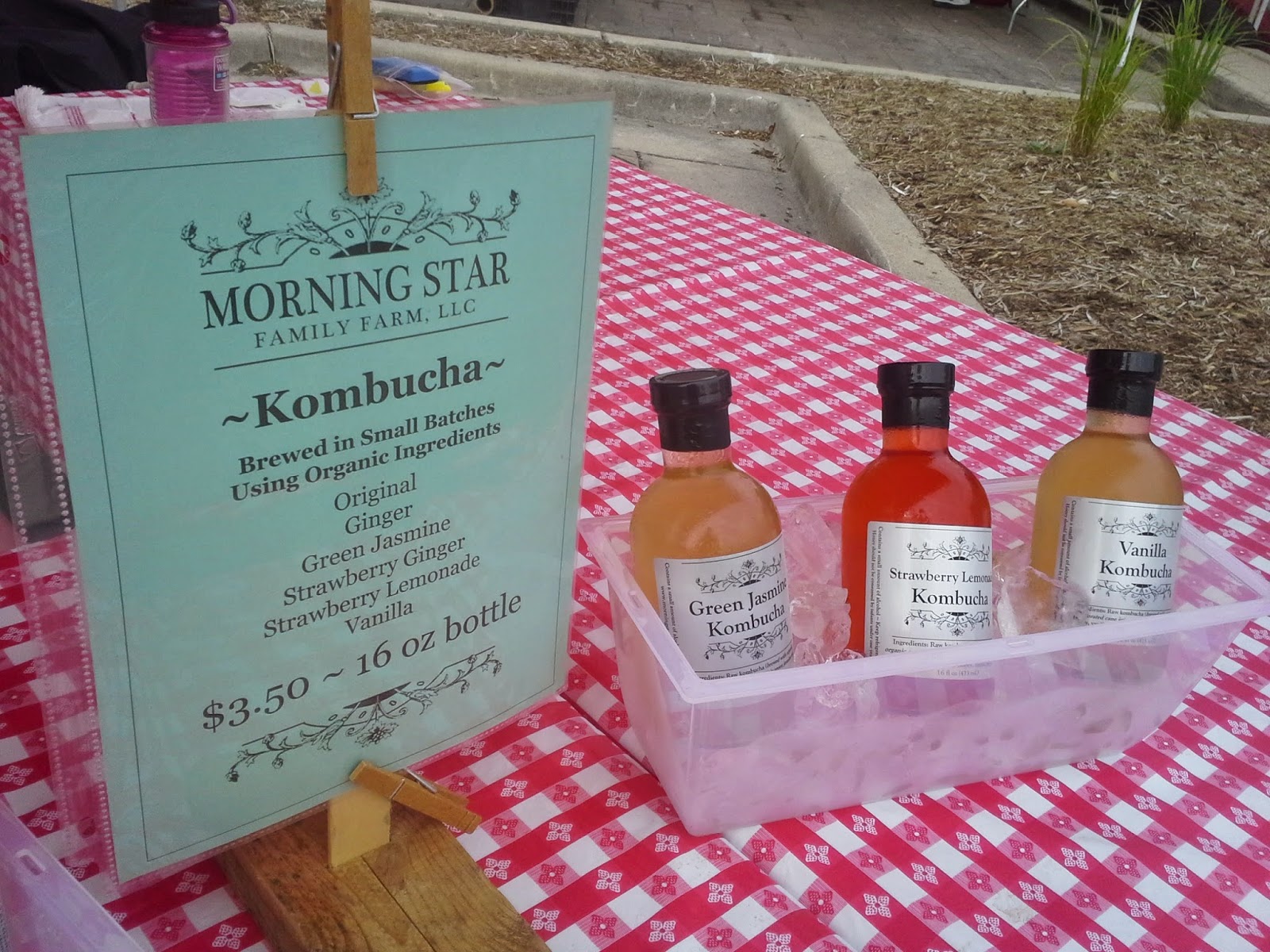
There is a refreshing drink out there that has been enjoying a surge of popularity among the health-conscious crowd.  It is kombucha.  A fermented, non-alcoholic tea, kombucha provides detoxifying benefits while quenching thirst. However, the drink hasn't always been well known.

As the story goes, there were two industrial towns in Russia on opposite sides of the same polluted river.  One town had a cancer rate significantly higher than the general population, while the other town did not.  Medical researchers were sent to interview residents of the two towns in an attempt to identify what lifestyle or diet choices may have caused such a variance.  

When the researchers entered the homes on the low-cancer side of the river, they often saw multiple odd-looking jars in the kitchen.  Upon inquiry, they learned that these jars were filled with kombucha, a drink which had been passed down by their ancestors and which was drunk on a daily basis by the residents of the town.

Rich in probiotics and enzymes,
our Kombucha is also
a delicious, refreshing drink

After hearing this story, our family began brewing kombucha for our own consumption.  Imagine our surprise that something with health benefits actually tastes good!  That was over a decade ago.   Now we produce kombucha for sale to our customers.  

Kombucha Soda is a healthy alternative
to regular soda.  Try Root Beer,
Ginger Beer, or Rye Kvass Kombucha Soda

We begin our kombucha with filtered water, organic tea, and organic cane sugar; then we add kombucha from a previous batch and a ‘scoby’, a patty of good bacteria and yeasts that will culture the tea.  When the fermentation is complete, most of the sugar and tea components, including caffeine, will have been consumed by the culture, leaving behind what is now called kombucha tea.  In the case of our flavored kombucha drinks, it is at this point that we add ingredients like organic ginger and strawberries, plus a touch of raw local honey, creating a taste sensation worth exploring.

Visit us at the market or at the farm
to give our kombucha drinks a try.

Our kombucha is available in several flavors at our farm, Good Harvest Market in Waukesha, and Health Hut in Brookfield, as well as at several local farmers’ markets.  Give it a try.  We think you’ll be as happy to discover kombucha as we were. 

Monday, September 8, 2014

Dog Days on the Farm

The dog days of summer are upon us, with hot, humid days and breezeless nights.  That term, dog days, is intriguing and, for me, brings about images of dogs, panting in the August heat.  Why did this uncomfortable season get linked with our canine friends?  It is during the summer months that our dog works the hardest here at Morning Star Family Farm. 

  
In conventional livestock farming, especially for chicken and pork production, keeping animals indoors 24/7 is standard procedure.  Among other things, this practice provides protection of the animals from predators.  When following the pasture-based model, as we do, decreasing predator pressure is a full-time job.  Who better than a dog to meet the challenge?


Rex is our resident guard dog.  While not a professionally trained livestock guardian dog, he still works hard to keep predators in the woods and out of our pastures.  Born on a farm and raised around the many species of livestock that we have, Rex has a keen sense of friend and foe when it comes to animals.  In addition, his very presence and scent helps to keep potential problem animals at bay.


 So, if dogs are so helpful, why do the hottest days of summer seem to be blamed on them?  According to Wikipedia, it has little to do with animals at all.  Apparently, the phrase “dog days of summer” has its origin in ancient times, in the nighttime sky.  Sirius, the dog star, would rise during the same time that weather would turn sultry.  Changes in the heavens have affected this correlation, but the name has stuck. 


This is good news for Rex and all of the other hardworking guard dogs out there, as it means that they are off the hook and free to go about their business of protecting livestock.  That is Rex’s part in helping us to get tasty, local foods from our farm to your table.

Friday, June 20, 2014

Starting Them Young

Selling our organic-fed meats and eggs at various farmers’ markets, we get to meet our customers face-to-face.  Lately we’ve noticed a trend among them.  Many young parents are actively seeking naturally-grown meats, eggs, and produce in order to give their little ones the best start in life.  Starting young is important, both for growing healthy bodies and for developing healthy habits.  We instituted our summer camps in an effort to help these attentive parents fulfill their desire to instill in their children an appreciation for wholesome food and ecologically-sound farming.  


Held in mid-June, our Farm Workers’ Day Camp gives 10-14 year olds a chance to try out life as a farmer.  Over the course of a week, the kids are given a taste of all of the jobs on the farm, from moving chickens to feeding calves.  It is our goal that they will come away from the experience with a realistic picture of what farmers do to grow the food they eat each day.


A little later in the summer, on the second Monday of July, 5-9 year olds assemble at the farm for their one-day Farm Explorers’ Day Camp.  These kids get to help collect eggs, pick garden vegetables, play with baby chicks, and feed the livestock.  They experience first-hand why animals are happier and healthier when they live outside in the fresh air and sunshine.


A little bit of education can go a long way towards improving the chances of today’s healthy food choices becoming lifelong habits.  If you’d like more information about our camps, please contact us through our website.  We’ll be happy to help your children or grandchildren see firsthand the connection between our farm and your table.

Sunday, May 25, 2014

Hope springs eternal.  After a long, cold winter like we just experienced, those words ring true more than ever.  We hope that the blustery winds and deep snowdrifts will fade into distant memories, and they do—spurred on by new leaves on the trees, and sales at the local garden center.  Who can resist spring, with its promise of new life?  Just planting a row of lettuce seeds, then seeing those tiny seedlings lifting their heads out of the soil, is gratifying enough to make one forget all about those below-zero days. 


Do you garden?  Many Wisconsinites do, even if only a few tomato plants beside the garage.  I’ve gardened for as long as I can remember and have fond memories of growing things in my youth—picking and nibbling on homegrown carrots while waiting for Dad to come home from work and, later, keeping a few bedding plants outside of my rental house in college.  Gardening keeps us connected—with the earth, with our food, with each other.  For city dwellers, even a small garden can be a way to feel like one can be, even in a small way, self-sufficient.


At Morning Star Family Farm, this year the focus of our garden will be growing ingredients for products from our processing kitchen.  Strawberries and black and red raspberries will provide a luscious palette from which we’ll create honey-sweetened jams.  If our young orchard makes a sizeable contribution, there will be plums, peaches, and apricots to turn into preserves as well.  We’ve made fresh, raw sauerkraut for ourselves for years; this year we’ll be making some to sell.


It is an experimental year of sorts, as we offer our products to our loyal customers for the first time, gathering feedback for next year’s products.  Is there something you would like us to grow or make?  Drop us a line and let us know.  Our customers are the driving force behind what we do here.  Looking for your feedback is one more way we seek to make the connection between our farm to your table.

Friday, April 11, 2014

"Eat Local" Starts Here

Duck….duck….duck….goose!  That old children’s game will come to mind later this month as baby chicks and ducklings descend on Morning Star Family Farm.  Having hatched the day before just an hour away at Abendroth Hatchery in Waterloo, the little chirping puff balls take their first road trip up to the farm.  It is a noisy ride home, but also one filled with excitement and anticipation.


Supporting a local hatchery, like Abendroth’s, is important for many reasons, some more obvious than others.  We vote with our dollars.  The money we pay to purchase these chicks and ducklings helps to support local agriculture.  Our customers buy our meats in order to do the same thing; buying our animals from neighboring farmers simply adds another layer to the “Eat Local” idea.


Buying from a hatchery within driving distance also decreases the stress that the birds endure.  Most chicks and ducklings must be shipped via the postal service in order to reach their new owners.  Two and even three days are not an unusual length of time for birds to travel by mail.  Freshly hatched chicks are able to last up to three days without food or water, as they are still consuming their yolk sac which they swallowed prior to hatching from the egg.  Long days and nights riding in trucks still do take their toll on the hatchlings, however.  In our experience, mail order birds are not as perky as those we get locally, and are more apt to succumb to sickness in the early days.  


And so, later this month, our newly hatched Abendroth chicks and ducklings will complete their short road trip and arrive at our farm.  We will carry the boxes of chicks into a special room in our barn that is set up for their arrival.  There will be freshly ground, certified organic feed available in various feeders around the room.  Warming lamps will be suspended above soft, clean bedding.  Waterers spiked with raw apple cider vinegar and sugar, two old time tricks for giving chicks a good start in life, will also be available.  This will be a temporary home for the birds, as they will be moving out to the pasture in just two weeks.  To introduce them to their new home, we will lift each chick from the box individually, help it to drink from a waterer, and then place it under the heat lamp.  Their pleasant, persistent chirps tell us that all is well on the farm.

Wednesday, March 26, 2014

March Comes In Like a Lion...

March in Wisconsin has always held the promise of coming in like a lion and going out like a lamb.  At our farm, it may come in like a lion, but it goes out with several lambs—Icelandic ones, that is.   


Born in March and April at a friend’s certified organic farm just 20 minutes away, the lambs spend each day at their mothers’ sides, learning about milk and hay and grass—it is their education in how to be a sheep.  After a few months, the lambs are ready to be weaned, leaving our friend’s farm for our pastures.  


Brought to Iceland by Vikings 1100 years ago, Icelandic sheep have remained pure as a result of their isolation there.  It is said that the Icelanders’ survival was dependent upon the Icelandic sheep’s meat, fiber, and milk.  As one can imagine, the rugged, cold terrain of the country also encouraged the sheep to become extra hardy themselves.


Because growing grain in Iceland is considered to be a difficult proposition, the Icelandic sheep evolved to grow efficiently on grass—thriving on quality pastures, but also surviving when given poorer grazing land.  Our sheep get the best of both worlds—excellent pastures, combined with a small amount of certified organic grain.  It is this formula that gives our lamb a taste that simply cannot be compared to store-bought meats. 


Raising heritage-breed sheep like the Icelandic has given us the opportunity to participate in maintaining this beautiful breed.  Our customers, in turn, get to experience the taste sensation of true organic-fed, pasture-raised, heritage lamb.  It is a situation which makes one look forward to the cold, wet days of March, knowing that they signal the coming of another lambing season for Morning Star Family Farm.


Friday, December 20, 2013

Philippine Typhoon Relief Fund Progress--Thank you!

With many thanks to all who have sent donations, we have collected $850 to date for the Philippine Typhoon Relief Fund.  A wire for the entire amount, less the bank's transfer fee, will be sent to Fr. Bart Pastor this coming week in order to arrive before Christmas.   We will send another donation in January to help with their ongoing needs, so don't despair if you haven't gotten a check sent yet.  There is still time!

[We have sent the final wire and are no longer accepting donations.]

Thank you again to all who have donated, either to our fund or through other organizations.  The need is so great, but even our small efforts are making a difference.  We look forward to sharing with you happy news from Fr. Bart after he receives the wire; we will update you all then.  Thank you and may God bless you for your generosity.

Friday, November 29, 2013

Help Us Help Others

200+ mile per hour winds.  Seafaring ships picked up and carelessly dropped in residential areas.  Roofs and walls of homes and buildings blown out of existence.  Over 1800 killed -- that's more than double the body count of Philippines' second most deadly typhoon.  These are the results of Typhoon Yolanda/Haiyan which struck central Philippines in early November.  According to news sources, over 673,000 are displaced and they still need help...your help.


As we remember all that we are thankful for on this Thanksgiving weekend, I would like to thank all of you who have expressed concern for my family in the Philippines.  Thank God they have been spared as they reside in northern Philippines while the typhoon ravaged the central region of the country.  Our family friend, Fr. Bart Pastor, a priest in Tacloban City, was not so fortunate.  He and his community were trapped in the middle of this natural disaster.  The following bio about him is written by my mother:

Fr. Bart Pastor is close to us, even from our Jakarta days.  He is a Thomasian, UST (Univ. of Santo Tomas) Theology grad in 1967.  He has written books, workshop materials, organized conventions and conferences, discipleship programs attended by local and foreign participants in their Paraclete Renewal Center in Tacloban.  His community has developed and formed self sustaining projects from farming, constructing school projects which their own qualified members implement...all these project assets and property and housing, farms were all damaged or destroyed by [Typhoon] Yolanda.  He is a simple, unassuming, gentle, fatherly, resourceful, selfless servant of God...and anyone who meets him for the first time surely gets beholden by this holy priest.


Fr. Bart Pastor has a unique ministry; he runs a retreat center sustained by its own farm which, in turn, provides jobs and opportunities for the locals.  My parents lost touch with him after Typhoon Yolanda/Haiyan struck the area on November 8, 2013.  About a week later, they finally received a text message from Fr. Bart saying that he was safe but that the typhoon claimed the lives of at least ten people from his community.  

Here are some actual excerpts from his text message to my parents:

...no electricity, batt, cellsite, load, radio, tv, food, water.  We lost 10 members and counting. Physical damage to Paraclete, agricultural n livestock estimated 12-15 million (Philippine Pesos).  D gudnews is we r still alive n surviving, d paraclete students n der families although no roofs n walls over dem.  So i invited dem to stay @ paraclete....  We r eating root crops blown coconuts unripe bananas by students who r still in hi spirits n prayin am n pm.

...Yes u deposit to metrobank ac later coz no banks r open yet afteryolanda....  I got out...we had to break d fallen cement posts just enuf height for the survivor to pass....  People der r hungry esp children in fact I invited several to stay at paraclete chapel, dorm....

...Foundational centr not destroyed, infact it was instrumental insaving lives of our immediate neibors who took refuge n 2nd n 3rd flrs. 4 floating bodies r still behind.  Our next neiybors homes r totally out.  the place where I stay completely gone walls n roofs.

...Stations 10-13 n risen Christ chapel gone.  Annies 10 cottages my residence all gone.piggery n poultry n veggies n fruit n foresttrees n coco trees complete gone.  Trees n coco r headless....  We shall rise agin by Gods grace n ur help!!!!!

People's faith persists in the wake of the typhoon as they worship in a roofless church.

Sometimes when we hear about tragedies that occur halfway around the world we can wonder if there is a way we can help, or if they are just too far away for us to be able to make a difference.  We would like to give you the opportunity to help someone who is on the front lines of this disaster, and to help his efforts directly.  

We are setting up a Philippine Typhoon Relief Fund account at a local bank here in Hartford.  Soon you will be able to send checks directly to that account so that we can wire the funds to Fr. Bart in Tacloban City.  

[We have sent the final wire and are no longer accepting donations.]

This is not a tax-deductible donation, but will go directly to Fr. Bart and his efforts to feed, clothe, and house those in his area who were struck by the typhoon.  

If you would like us to keep you informed about the progress of the Philippine Typhoon Relief Fund, including the amount of money collected and the dates that the funds are wired to Fr. Bart, please include a note with your check, or send us an email.

Thank you in advance for your generosity.  May God bless you and reward you.

Wednesday, July 31, 2013

More Fun than Expected

Our education about healthy living should not begin as an adult, but rather, as a child.  In order to bridge the gap between the farm and one's dinner plate, on Monday, July 15, 2013, a group of young children descended upon our farm. 

The children came here because their parents had signed them up for Farm Explorers' One-Day Camp, a camp designed to allow children to get a glimpse of farm life, plus learn why animals are happier and healthier when they live outside in the fresh air and sunshine.  


10:00 -- Orientation
After checking in, the group gathered under the canopy and began working on an activity packet that included coloring pages of the animals they would see later in the day.  At the sound of the cow bell (what else?) we started with a prayer, an explanation of the day's plan, and, most importantly, a discussion about how to stay safe around the farm.

10:15 -- Morning Activities
The children were divided into two groups and rotated through two learning stations.  At the Chick Station, Group 1 learned all about the one week old chicks growing in the granary of the big barn.  

The Chick Station
(It was 90 degrees in there!
But that's how the chicks like it.)

Gently playing with baby chicks

At the Pasture Station, Group 2 learned about the animals we raise on the pasture: broiler chickens, cattle, and sheep. 

The Pasture Station
Learning about the origins
of grass-fed beef
Meeting our pasture-raised chickens
Feeding the hogs broccoli from
 our garden while waiting
for the lunch bell

12:00 -- Lunchtime!
The sound of the cow bell called everyone to the canopy for lunch.  Plenty of shade and ice water made a wonderful combination!  A little free time after lunch gave the kids time to pet the farm dog, cats, and rabbit.  The more "mechanically-inclined" enjoyed riding on the parked tractor, skid steer, and riding lawn mower.


12:30 -- Afternoon Activities
In the second half of the day, we offered two more learning stations for the children.  The Egg Station involved collecting eggs from the chickens' nest boxes, washing and drying them, and then packing the eggs into a mini-carton to take home.  

The Garden Station gave the kids a tour of the 1.2-acre fruit orchard and vegetable garden.  The children were happy to identify plants like corn and pumpkin, and learn about others like grape vines and potato plants.  Then the kids got to harvest a basket-full of sugar snap peas to take home with them.


2:00 -- Dismissal
While our main goal in hosting this camp was to educate the kids about why we do the things we do, we also had, at the forefront, a desire for the kids to have a lot of fun.  While it was obvious that the children had a good time (one little boy even said, "That was more fun than I expected!"), I think the adults may have enjoyed the camp even more than the campers.  

We have to make many decisions on our farm; we always make those decisions with an eye towards those who will be eating the foods that we produce.  There is something special about seeing firsthand the children who are benefiting from those decisions that we are making.  Fifteen happy, healthy children enjoying the safe, chemical-free farm we have worked hard to create--it was a beautiful sight to see.


The tractor, Old Red, carries the happy campers during the group photo.
     
Thanks for a great Farm Camp, everyone!
We hope to see you again next year.


Monday, April 15, 2013

A Winter Recap

It has been a long winter, and it seems that spring is taking its sweet time in arriving this year.  That makes it a great time to share with you what we've been up to this winter at Morning Star Family Farm.

This winter has been a productive one for completing projects.  First on the list was finishing up the barn pens.  The boys built a total of thirteen pens in our 100+ year-old bank barn.  
First, the boys frame out
combination stock panels with 2 x 4s.
Then they attach the framed panels
to 2 x 4 uprights.
The final result: modular pens that can be
altered as needed for different uses.  This one
is sized for a newborn calf or young pig.
While we'd much prefer our animals living outdoors year round, our Wisconsin climate just doesn't work well with that plan.  Instead, we try to bring our animals the best of both worlds during the winter months--24 hour access to the barnyard for fresh air and sunshine, and a cozy, bedded retreat inside the barn for a place to get out of more severe weather.
The steers make a great thermometer.  If it
is over 25 degrees, you will find them outside.
Stella goes outside for some sunshine.

The growing hogs enjoy the fresh air, too.
The chickens, on the other hand, are not
thrilled to be out in the snow.  They hang out
near the coop door until one of the boys
shovels a path for them.
Now that we have survived the 2012 drought, and have seen a lot of precipitation throughout the winter, we are thinking that our pasture will be ready for animal traffic this year.  As a result, we will need pasture housing for both laying hens and hogs.  The pasture layer house was Raphael's project.
The inside of the pasture layer house, with
roosts on the left and nest boxes on the right.

Built on skids, the house can be pulled with
our tractor to a different area of the pasture.

A view of the back of the layer house,
showing the access door to the nest boxes.

The completed layer house,
ready for a coat of paint.
Meanwhile, Dad offered to build the hog pasture housing.  We knew the house needed to be large enough for a litter or two of growing-out hogs, and it needed to be easily divided so we could separate a farrowing sow from the rest of the herd.  The resulting 8 x 16 foot structure meets these criteria and then some.

Doubled 2 x 6s provide strong skids for the new hog shelter.  Dad built the house to be held together with strong bolts as well.  As a result, he can build the shelter in our upper barn, then disassemble it for transport to the field.  We will use the skids for transport within the pasture as needed.
Skids on, side walls up, and the beginnings of
overhead supports for the hog shelter roof.

The heavy steel roof must go up in two 
sections to be practical.  Here is the framing 
for the first section.

The first roof support section, in place
on the hog shelter.
So, despite the snow and cold, it has been a productive winter for us here at Morning Star Family Farm.  Stay tuned as we complete these projects and, once the grass gets growing, move the animals out onto pasture where they can benefit from not only the fresh air and sunshine, but green grass as well.

In the meantime, check out our website for our current offerings: cuts of Grass-Fed Beef, Organic-Fed Stewing Hens, and Organic-Fed Eggs.  We are also taking orders for upcoming organic-fed, pasture-raised products: Broiler Chickens in summer 2013 and Pork, Lamb, and Turkey in fall 2013.  Send us an email or give us a call to reserve yours today.